Road tunnels are underground routes that allow vehicles to pass through obstacles such as mountains or bodies of water, often providing a more direct path. According to our research into the world’s longest and deepest tunnels, there are 44 significant road tunnels in the US, many of which reveal striking tunnel views as you emerge on the other side.
Driving through a tunnel creates unique conditions that demand extra care and attention. Factors like reduced visibility, confined space, artificial lighting and altered acoustics can affect how drivers judge their surroundings and react to potential hazards. For these reasons, understanding tunnel safety is essential.
This guide provides guidance on road tunnel driving in the US. Whether you are navigating one of the longest highway tunnels in the world or are planning a road trip via one of the famous tunnels in the US named after influential figures, this guide covers essential preparation, key safety tips and how to respond effectively in unexpected situations.
This content provides general guidance on driving through highway tunnels in the United States and it does not constitute official legal or safety advice. Road rules, signage and safety recommendations may vary by state and are subject to change. If you are driving outside the US, you should consult the relevant authorities or official road safety guidance for that country to ensure you are following local laws and best practice.
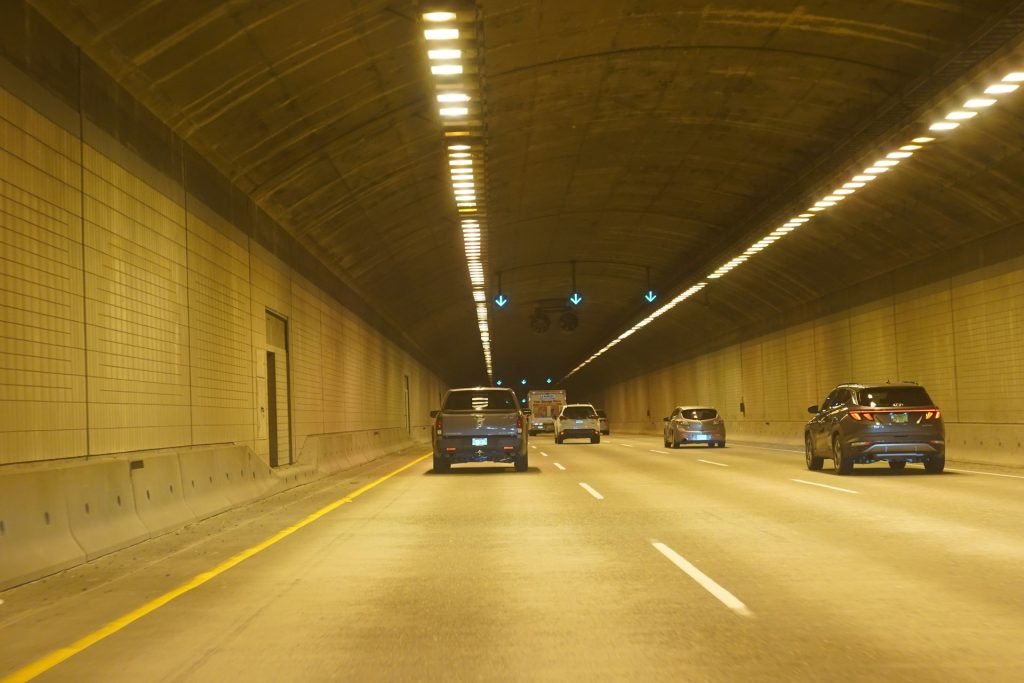
Before entering a highway tunnel
Preparing in advance can help you avoid sudden reactions when entering a tunnel. Before you reach the entrance:
- Check your fuel level and ensure your vehicle is running properly
- Turn on your headlights early, even in daylight
- Remove sunglasses to allow your eyes to adjust more quickly
- Position your vehicle correctly and avoid last-minute lane changes
Tips on driving through a tunnel
Whether you’re navigating the Holland Tunnel in New York or passing through the Eisenhower-Johnson Memorial Tunnel in Colorado, the following tips will help you stay safe, alert and in control as you’re driving through a tunnel.
When you rent a vehicle with SIXT, you can drive with added confidence knowing our vehicles are equipped with the latest safety features. By combining smart driving habits with a well-equipped vehicle, you’ll be ready to handle tunnel driving with ease.
Ensure all loads are secured properly
Before you start your engine, double-check any external luggage, roof racks or bike carriers. A fallen object in a highway tunnel creates a major hazard that is difficult for others to avoid.
Remove sunglasses
As you approach a tunnel ahead road sign, remember to take off your sunglasses. The sudden drop in natural light can drastically reduce your visibility for the first few seconds of entry, making it harder to spot hazards.
Use low beams
One of the most frequent questions drivers ask is: which lights should you use in a tunnel?
You should always use your dipped headlights (low beams). These ensure you are visible to others without dazzling drivers in the rearview mirror. Even if a tunnel is well-lit, your taillights help those behind you gauge distance.
Maintain lane position
Tunnels can sometimes feel narrower than open highways due to the proximity of the walls. It is vital to stay centered in your lane and avoid unnecessary lane changes unless directed by signage or officials.
Leave a safe distance from other vehicles
In the US, the recommended following distance for passenger cars is at least 3-4 seconds behind the vehicle ahead in ideal driving conditions. In poor weather, heavy traffic or at higher speeds, increase this distance to 5-6 seconds or more.
Pay attention to all road signs and traffic signals
Tunnels are heavily monitored. Watch for variable message signs, speed limit changes and “Red X” signals, which indicate a lane is closed ahead.
Stick to the speed limit
Speed limits in tunnels are often lower than on the open highway to account for reduced visibility and limited escape routes. Always adhere to the posted limit to maintain a steady traffic flow.
What to do in congested traffic in a highway tunnel
Heavy traffic can be more stressful underground. If the flow of vehicles slows or stops, remain calm and follow these protocols:
Listen to media updates
Listen to local traffic radio or Public Address (PA) systems for instructions.
Maintain a safe distance from other vehicles
Even in stop-and-go traffic, keep at least 5 meters (16 feet) of space between you and the car in front.
Follow the instructions of DOT officials, State Police and message signs
Adhere to the directions provided by Department of Transportation (DOT) officials, State Police or electronic message signs. If traffic is completely stationary, turn off your engine to prevent the buildup of exhaust fumes, but stay inside your vehicle.
What to do if you break down or are in an accident in a highway tunnel?
Breaking down or being involved in an accident inside a highway tunnel can be a challenging and high-pressure situation. When you rent with SIXT, you can rest assured you’re choosing a modern and reliable vehicle, though the following guidance outlines the key steps to take should the unexpected happen.
Remain calm
Panic can lead to mistakes. Remain calm and focus on getting your vehicle to a safe spot.
Turn on hazard lights
Signal to others immediately that your vehicle is stationary by turning on your vehicle’s hazard lights.
Turn off the engine
Once stopped, turn off the engine but leave the key in the ignition (or the fob in the car) so emergency responders can move the vehicle if necessary.
Put on a high-visibility vest
If you must exit the vehicle, ensure you are visible to other drivers by putting on a high-visibility vest.
SIXT equips every rental car with a free safety vest. They are highly visible and reflective, allowing other drivers to spot you from a distance.
Use your cell phone or locate the closest emergency phone in the tunnel and call for help
While you can use your cell phone, the emergency phones located every 50–100 meters connect you directly to the tunnel control room, which can immediately track your exact location via CCTV.
Wait for assistance in a safe location
Move to a designated emergency walkway or stay behind a safety barrier if one is available while you wait for assistance.
What to do if there’s a fire in a highway tunnel
While rare, tunnel fire safety is the most critical aspect of underground driving. Smoke is often more dangerous than the fire itself in an enclosed space.
Stop, turn off the engine, and exit your vehicle
If your car catches fire, try to drive it out of the tunnel. If that is impossible, pull over, stop the engine and leave the vehicle immediately.
Do not attempt to retrieve personal belongings.
Call 911
Use your mobile or an emergency SOS phone to alert the authorities.
Follow the instructions of emergency personnel
Listen for announcements over the public address system. Follow the directions of the Fire Department, State Police and tunnel officials.
Exit at the nearest tunnel entrance, unless directed otherwise
Follow the illuminated signs to the nearest exit. These exits often lead to a separate, pressurized safety corridor.
Assist others if you can
If it is safe to do so, help passengers or other drivers reach the emergency exits.
Exiting a Tunnel Safely
- Allow your eyes to adjust, do not accelerate suddenly, focus on the road as your vision adapts to daylight
- Maintain a safe distance, keep space between you and the vehicle ahead as traffic may speed up suddenly
- Watch for merging vehicles, tunnel exits often connect to highways or interchanges, stay alert
- Put sunglasses back on if needed once you’re fully out and visibility is stable
Common mistakes to avoid when driving through a tunnel
- Braking suddenly when entering the tunnel
- Forgetting to turn on headlights
- Following too closely behind other vehicles
- Changing lanes unnecessarily
- Ignoring overhead lane signals and signage
Plan your next road trip with SIXT
Ready to experience some of the world’s most iconic tunnel views for yourself? Whether you’re heading to one of the most famous tunnels in the US or exploring scenic tunnel routes in Europe, having the right vehicle can make all the difference.
When you rent a car with SIXT, you gain the peace of mind that comes with a premium, well-maintained fleet. Our vehicles are equipped with the latest safety features, ensuring you are prepared for any driving conditions – underground or otherwise. Plus, with branches across the US and globally, you can easily pick up a car in one state and drop it off in another, giving you the ultimate freedom to explore.
While this article focuses on guidance for driving through road tunnels in the United States, be sure to review official road safety guidelines when visiting other countries, as local rules and recommendations may vary.